
Urban Housing Solutions that aren't Soviet
"Strong Towns" and "Housing-Ready Cities"

I’ve been keeping an eye on the “Strong Towns” movement for a while now, but took a closer look when their Chief Technical Advisor, Edward Erfurt spoke at the Congress for New Urbanism in Tampa, August 2025. New Urbanism is, of course (“of course” 🙄), “a planning and development approach based on how cities and towns had been built for the last several centuries: walkable blocks and streets, housing and shopping in close proximity, and accessible public spaces.” It focuses on “human-scaled urban design.” This is being offered as an answer to the suburban model that America has embraced over the last 75 years.
Paul Krugman, Nobel Prize winning economist, argues that we’re reaching the limits of sprawl due to issues with affordability and traffic. You should read his Stack, but the basis of the argument is that Atlanta used to have plenty of space, so citizens could build houses affordably and workers could commute into the business centers. Now traffic has gotten so bad that you can’t build houses in the suburbs that people will buy. So supply goes down, prices go up, and a big draw of the city (affordability and access to “city”) is taken away. It’s affecting people’s ability to date as well:
The idea of “New Urbanism” piqued my interest, so I reached out to one of my connections in the Bay Area economic development scene: President of the Plant City Economic Development Council, Steve. The conversation went something like this:
Steve: “Hey James I saw your LinkedIn message. I wanted to call. So you’re looking into new urbanism huh?”
James: “Yeah there was some conference in Tampa this week. What’s all that about?”
“Awh I don’t really know man but it’s all this stuff about walkable neighborhoods and 15 minute cities and urban density and what not.”
“Yeah it seems interesting. There was a walkthrough of Hyde Park. I guess they won some sort of award.”
“I don’t know anything about Hyde Park, but I’ll tell you what. You know who was great at building dense urban cores and 15-minute cities? The Soviets during the Cold War with their block housing. Sometimes people just want to own a house. Anyway, I’ve got to go. Call me whenever.”
So aside from being a very funny thing to say about walkable neighborhoods, it was pretty thought-provoking. I don’t have all the answers, but some people think they have most of them. That’s where Strong Towns comes in. It’s a grassroots movement and nonprofit organization that is working to replace the “suburban experiment” with development that is “financially strong and resilient, creating cities that are safe, livable, and inviting.”
Large cities do not have this figured out, but they’ve sort’ve got it figured it out. NYC is dense, livable, and safe, with effective public transportation. It has affordability issues. I’m not sure how they are going to solve those. When I was in Chicago it felt similar, but - as I noted in my Stack about that trip - more nodular.
I’m not particularly concerned or interested in large city’s affordability and density issues. I am, however, really interested in small to midsized city’s affordability and density issues, and I think that’s where the Strong Town playbook thrives. It also addresses Steve’s concern about soviet-era block housing (total non-issue by the way). In Strong Town’s “The Housing-Ready City: A Toolkit for Local Code Reform,” their policy advocates recommend 6 adjustments. You could go read their toolkit, but I’m going to walk through each of the recommendations here in a sort’ve abridged version. Before I do, a quick note. Strong Towns has a step-by-step checklist for implementing each of these policies. It’s slightly different for each one, but it generally follows this order:
Amend the zoning code.
Simplify the permitting process.
Educate stakeholders on the changes.
Now, onto policy.
Policy #1: Allow Single-Family Home Conversion to Duplex or Triplex
There are a lot of old houses that are large because they were built for the American Nuclear Family. Now, America is changing and houses don’t need to be that big. Right now in most municipalities, special permits and permissions are required to turn single-family homes into duplexes or triplexes. Hugely taxing.
Allowing single-family home conversion creates more space without added infrastructure. It also creates opportunities to give young people a chance to stay in their neighborhoods. Instead of having to move far from home after being priced out of where they grew up, single young professionals or students can find 1/1s inside of an existing home. These conversions also allow homeowners to create an independent space for an aging relative. This gives all involved a bit more privacy and dignity. “The Housing Ready City” also points out that conversion into triplexes can increase home value therefore bringing in more tax revenue for the cities. A win-win for the homeowner and for the city.
Policy #2: Permit Backyard Cottages in All Residential Zones
Backyard cottages, or accessary dwelling units (ADUs), have a lot of the same benefits as single-family home conversion, but instead of it happening within the home, it happens on the property. An ADU is a new building, usually tucked behind an already standing home, and “increase housing supply while preserving the character of neighborhoods.” Great for downsizing families, aging relatives, or children that want an affordable option close to home.
Obviously there need to be guidelines but added flexibility increases supply. In Fayetteville, AK they loosened the reigns on development and legislated against the actual problems: over-occupancy, illegal parking, noise complaints, etc.
Policy #3: Legalize Starter Homes in All Residential Zones
“Starter homes” are not explicitly illegal, but zoning laws that create minimum housing size requirements make it functionally impossible to build small homes. The policy guide describes a case where a young family was able to buy an 850 sqft home on a 3,000 sqft lot in Downtown Pensacola, FL. Because the home was in their budget they were able to redo the kitchen and living room to suit their needs. They’ve also got room for improvement. The attic could be turned into a third bedroom and there’s room on the lot for an ADU as their family grows.
I see homes like this in my own cities. In Lakeland’s historic districts that surround Downtown and Dixieland we see shotgun style homes all over the place. This allows young families affordability without sacrificing accessibility to the downtown area.
Policy #4: Eliminate Minimum Lot Size Requirements in Existing Neighborhoods
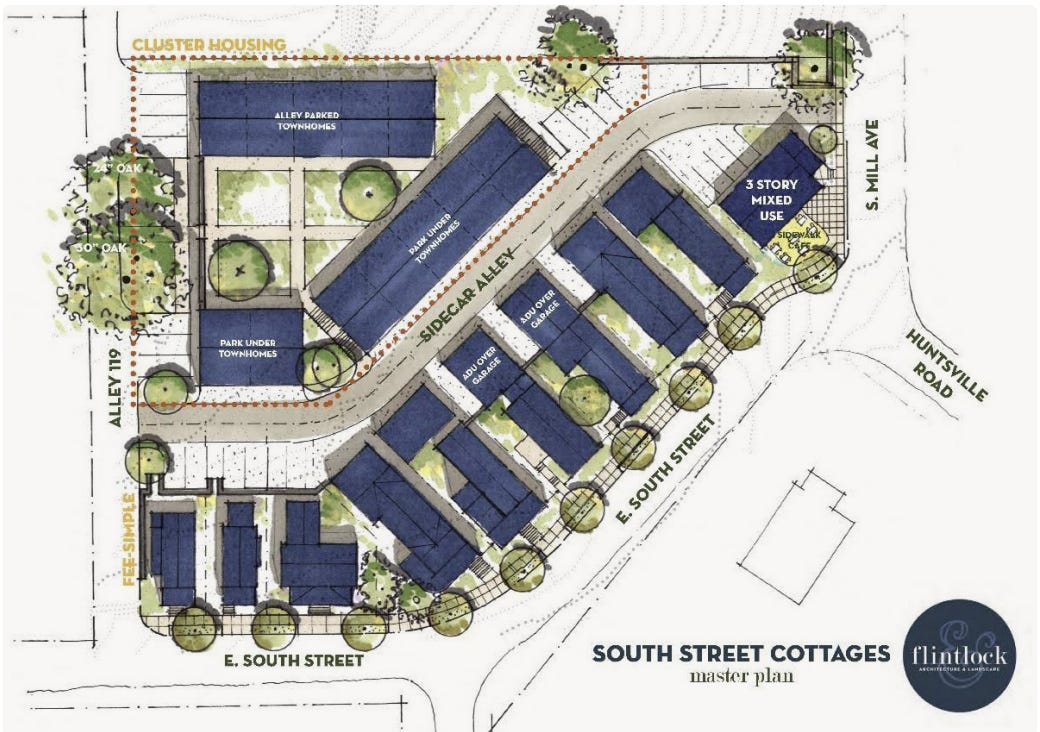
Eliminating minimum lot sizes in existing neighborhoods allows flexibility in development. I can’t really do this section justice and highly recommend reading Strong Town’s case study. By reducing lot sizes, an architecture firm was able to fit 28 homes on a parcel that would’ve only allowed 7 previously. These homes can be bought outright using typical mortgages allowing young families, single professionals, and retirees a pathway to homeownership (a cornerstone of the American Dream). The parcel also ended up including a 3 story mixed use building, continuous sidewalks, and adequate greenspace. See below for a bird’s eye view of what the neighborhood looked like after development.
Policy #5: Repeal Parking Mandates for Housing
See below:
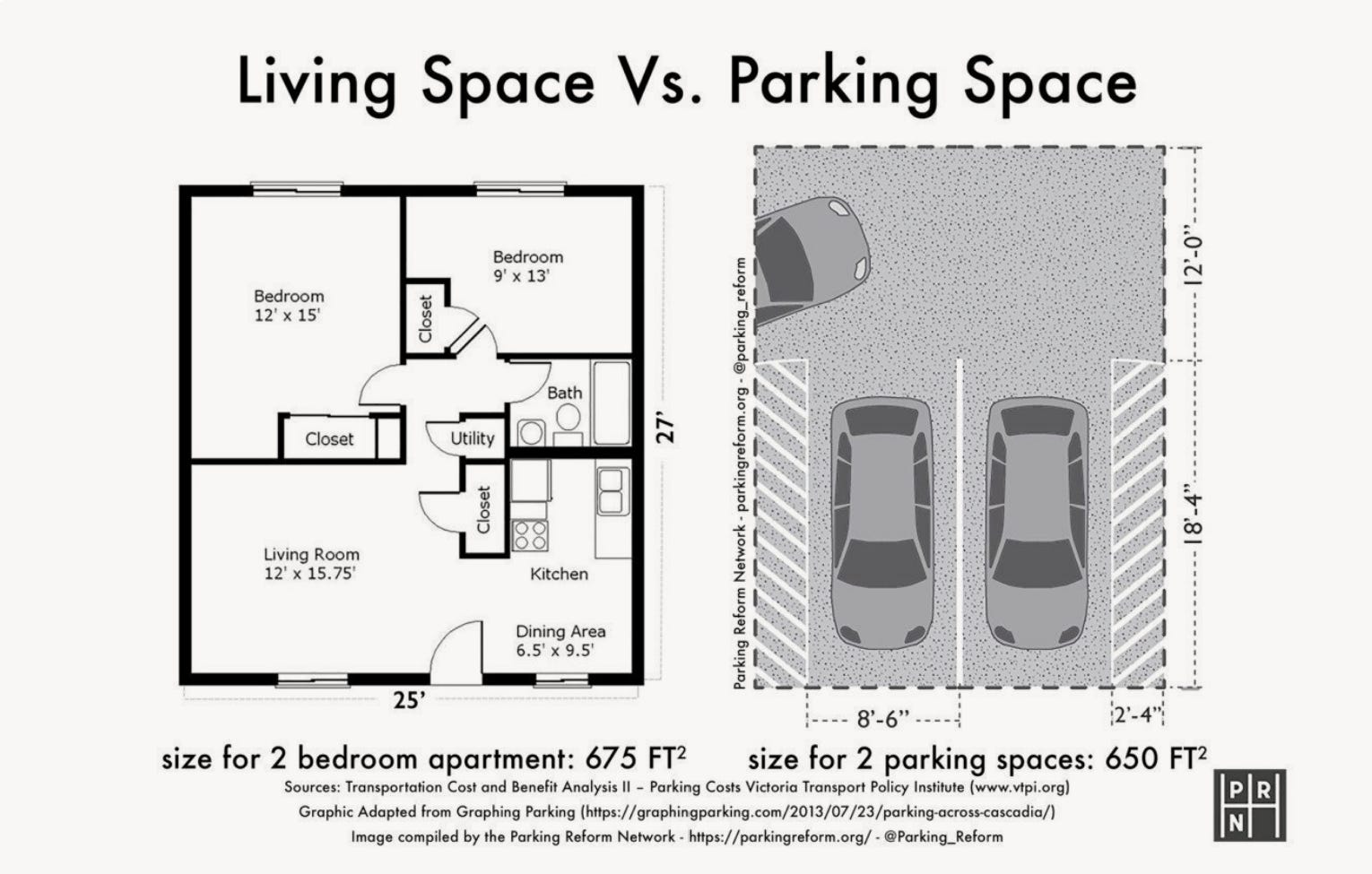
This is not sustainable or affordable and is antithetical to walkable neighborhoods and accessible public spaces.
Policy #6: Streamline the Approval Process
This just goes without saying. If it’s easier to get approved developers can spend less time on that process and more time on actually….developing. More time = more money = less affordable. South Bend, IN has a set of preapproved homes that they can approve in as little as 20 minutes. Spearheaded by the now famous (in some circles) Tim Corcoran - who apparently found the first zoning rule he would cut within an hour of his time on the job as the Director of Planning in South Bend - they are one of the midsized cities leading the nation in zoning reform. Also, somewhat notably was led by Pete Buttigieg from 2012-2020.
GovWell is doing some interesting work in the private-sector here. They’ve developed an AI platform that sits on top of city’s existing CRMs/processes. It streamlines and modernizes planning and zoning workflows and customer-facing portals. It definitely has the look of your typical “AI-powered” platform in the SaaS-era of tech, but if that’s what people are used to, and it makes it easier to use than by all means, make my city’s website look like Uber.

Wrap Up
I wouldn’t exactly describe this Stack as technical - largely because I don’t know enough to make it technical - but it certainly was less punchy than some of my previous stuff. Clearly something needs to change. America is maturing and we’ve got all of these cities that either existed for something that no longer powers them or are reaching the natural end of their experiment in urban sprawl. People are fed up and we need to make adjustments. I found this document that had a few adjustments and I liked em. I hope you do too.
MUSICAL CODA